
Why do female athletes suffer more cruciate ligament injuries? Hormone cycle, rest and strength could hold the answer
The San Juan de Dios University School of Nursing and Physiotherapy - Comillas leads a line of research that studies how to prevent the rupture of the anterior cruciate ligament in women's sport
23 May 2025
Ruptured anterior cruciate ligament (ACL) has become one of the biggest threats to women's sport. Names such as Alexia Putellas, double Golden Ball winner, the American basketball star Breanna Stewart or the badminton Olympian Carolina Marín, have put a face to a worrying statistic: women suffer ACL injuries up to four times more than men in sports such as football or basketball.
Faced with this reality, the San Juan de Dios University School of Nursing and Physiotherapy - Comillas (EUEF) is developing research that seeks to identify new keys to prevention, focusing on variables that have not yet been explored: the menstrual cycle, muscle strength, rest and recovery.
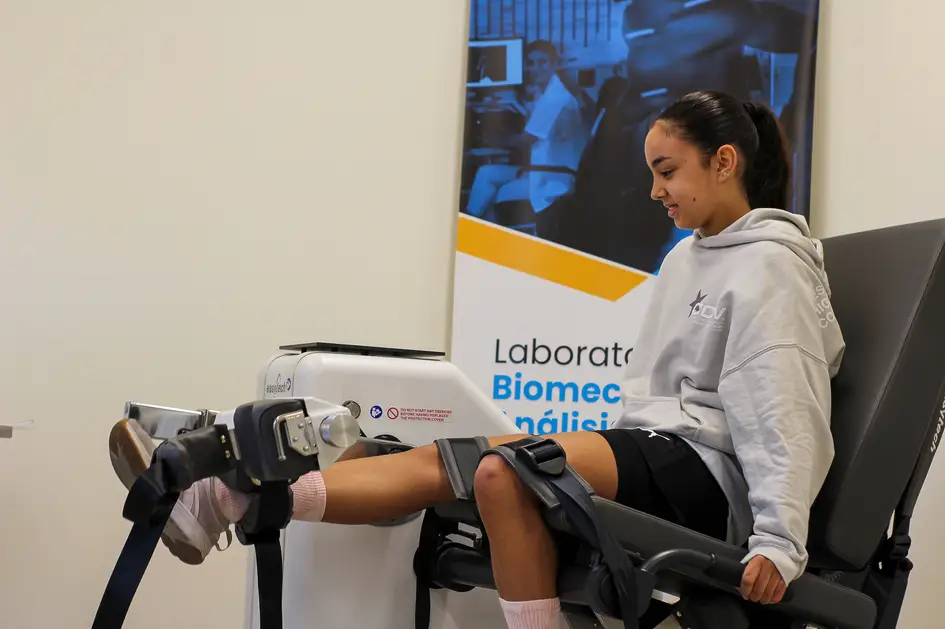
This study is part of a broader line of work that the group has been developing since 2020, initiated by Néstor Pérez, head of the Biomechanics and Physiotherapy Laboratory of the EUEF. Since then, biomechanical data has been collected from athletes of different levels and disciplines. The group's accumulated experience in previous studies with high-level athletes now makes it possible to address in greater depth the specific factors that could be behind the high number of ACL injuries, especially in women.
"Knowing what happens to strength during the menstrual cycle can help us to adapt recovery and prevention plans to the situation of the players, which will result in improved performance and fewer injuries," explains Raúl Coto, professor and researcher at the EUEF.
In fact, one of the latest studies published that analyses players from the Movistar Estudiantes basketball club shows that lower strength in the flexor muscles may predispose players to suffer knee injuries.
"We cannot yet give conclusive figures, but the trend observed in our measurements indicates that adapting training to female physiology could significantly reduce the risk of injury," says Néstor Pérez.
In addition, the group has carried out parallel work with male athletes that has already led to recent scientific publications. These studies have analysed, among other factors, how the position of the dynamometer or the angle of the knee affects the balance between the hamstring and quadriceps muscles, a key parameter in the stability of the joint.
"Over the years we have collected data from healthy players, injured players and players at different competitive levels. Thanks to this base, we can speak with scientific evidence about when and why these injuries occur, and how to prevent them at the root. This study is just the beginning of a series of publications that we have underway for the coming years," explains Mª Jesús Martínez, professor and researcher at the EUEF.
Another of the differential aspects of this research is its comprehensive approach: not only does it analyse strength or sporting gesture, but also the role of rest, sleep and recovery. Variables that, although often underestimated, can make the difference between maintaining performance or suffering an injury.
"Rest is as important as training. We have identified how poor sleep management or recovery between matches can increase the risk of injury," says Lucía Cuéllar, also a member of the EUEF research team.
A proposal for change in sports prevention
The ultimate goal of this line of work is to transfer the knowledge generated to clubs, federations and sports medical services. Being able to personalise the workload according to the hormonal cycle, correcting muscular imbalances or adjusting rest times can mark a turning point in the way in which sportswomen train and protect their health.

Researchers and students from the Comillas Clinical Psychology Unit take part in some of the leading international psychology conferences.

The EMS 2026, held at Comillas ONEXED, has cemented Comillas’ position as a leading forum for dialogue between knowledge, leadership and innovation

The Comillas ICAI Chair in Smart Industry, together with the ICADE Business Club, hosted another instalment of the “Breakfasts with CEOs” series, the last one of this academic year